When Arthur Hills designed Addison Reserve Country Club in 1996, he faced a challenge familiar to Florida architects: transforming 653 acres of flat terrain into compelling championship golf. The result demonstrates why Hills became one of America's most prolific course designers, with his three nine-hole configurations at Addison Reserve representing a masterclass in strategic routing and environmental sensitivity.
Course Overview
| Specification | Details |
|---|---|
| Total Holes | 27 holes (three 9-hole courses) |
| Course Names | Trepidation, Redemption, Salvation |
| Total Yardage | 7,150 yards per 18-hole combination |
| Par | 72 (each 18-hole combination) |
| Architect | Arthur Hills |
| Opening Year | 1996 |
| Acreage | 653 acres |
| Membership | Full Golf, Partial Golf |
| Initiation Fee | $150,000 |
The Arthur Hills Legacy
Arthur Hills compiled one of the most extensive portfolios in modern golf architecture, designing over 180 courses across four decades. Born in 1930, Hills studied landscape architecture at Michigan State University before establishing his firm in 1963. His Florida projects, totaling more than 20 courses, showcase his adaptation to the state's unique challenges: poor drainage, minimal elevation change, and environmental constraints.
Hills developed a reputation for creating strategic interest without relying on dramatic topography. His courses typically feature generous fairways that narrow strategically, multiple tee positions to accommodate varying skill levels, and greens complexes that reward precision while offering recovery options for errant shots. At Addison Reserve, these principles manifest across 27 holes that can be combined into three distinct 18-hole experiences.
The architect's approach to Florida golf emphasized playability over punishment. Rather than creating penal hazards, Hills used subtle contours and strategic bunkering to guide play and create decision points. This philosophy proved particularly effective in resort and high-end residential communities, where diverse membership skill levels demanded thoughtful design balance.
Signature Holes Across Three Courses
Trepidation Nine
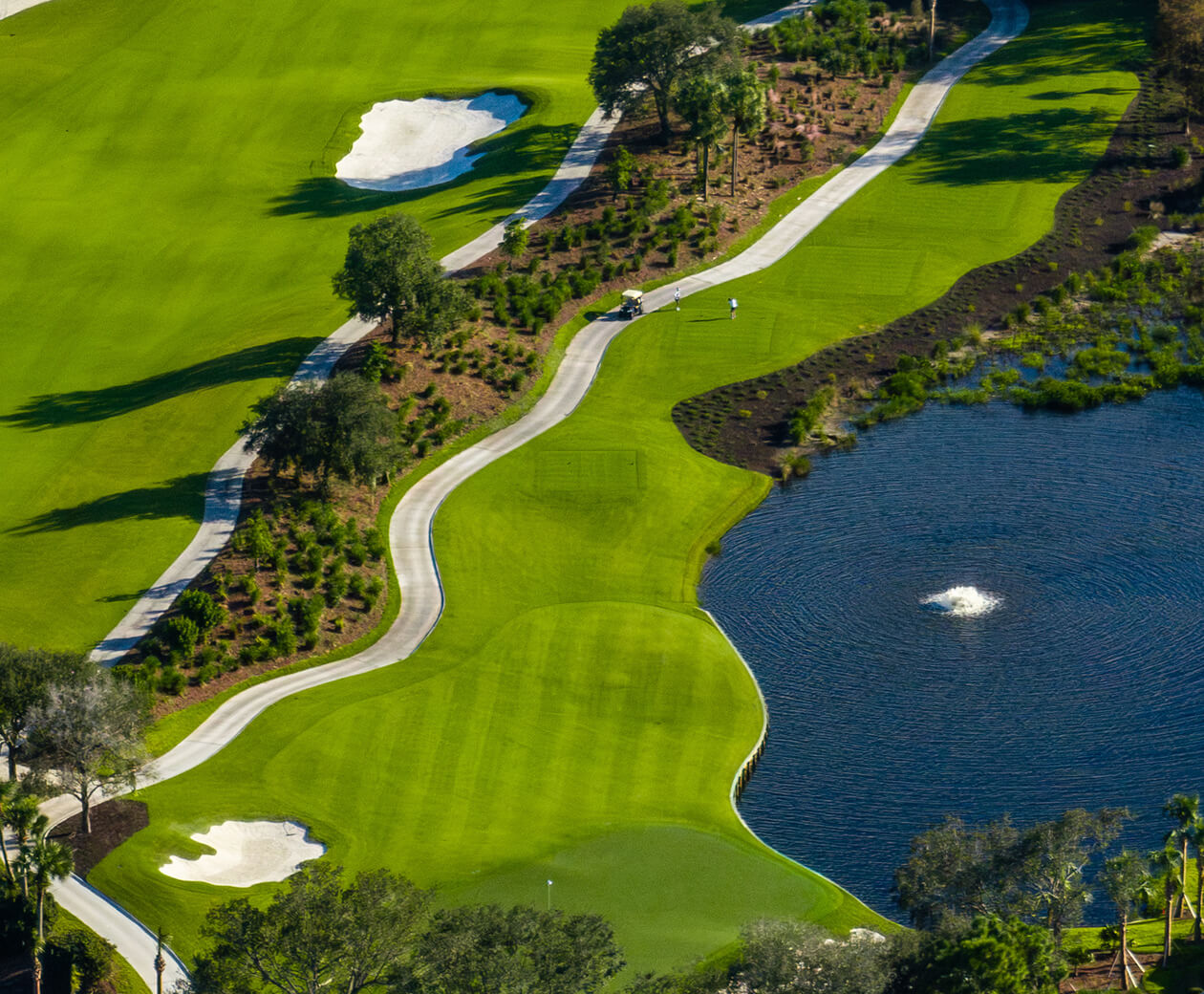
The opening course lives up to its ominous name with holes that demand strategic thinking from the first tee. The par-4 4th hole exemplifies Hills' Florida design philosophy, presenting a dogleg right with water guarding the green approach. At 425 yards from the championship tees, it requires a precisely placed drive to set up the optimal angle for the second shot.
Redemption Nine
The middle course offers opportunities to recover from earlier struggles, though Hills ensures these chances come with their own strategic puzzles. The par-5 6th hole stretches 545 yards and features a split fairway design, allowing aggressive players to challenge the direct route over water while providing a safer bailout option to the left.
Salvation Nine
The final nine concludes with holes designed to test every aspect of a player's game. The closing stretch includes a demanding par-3 that plays over water to a green protected by multiple bunkers, requiring precise club selection and execution under pressure.
Hills' three-course routing allows for varying combinations, with each 18-hole arrangement offering a different character and challenge level. This flexibility proves particularly valuable for member events and varying seasonal conditions.
Practice Facilities
Addison Reserve's practice amenities focus on comprehensive game improvement rather than sheer scale. The driving range provides adequate space for full swing practice, though specific yardage and target details remain club-proprietary information.
The facility's integration with the club's coaching program represents a modern approach to member development. Professional instruction combines with practice facility access to create systematic improvement opportunities for members across all skill levels.
Conditioning Standards
The club's commitment to agronomic excellence reflects its status among Florida's elite facilities. Addison Reserve has earned recognition as a Platinum Club of America and Platinum Club of the World, designations that require demonstrated excellence in course maintenance, service, and overall club operations.
South Florida's climate presents year-round maintenance challenges, from summer heat stress to winter overseeding requirements. The club's grounds department manages these seasonal transitions while maintaining tournament-quality conditions across all 27 holes.
Water management represents a critical component of course conditioning in Florida. Hills' design incorporated extensive drainage systems and strategic water feature placement to address both playability and environmental concerns.
Rankings and Recognition
Addison Reserve has achieved multiple industry recognitions that validate its design and operational excellence:
| Award | Organization | Significance |
|---|---|---|
| Platinum Club of America | Club Leaders Forum | Top 1% of private clubs nationwide |
| Platinum Club of the World | Club Leaders Forum | International recognition for excellence |
| Distinguished Elite Club | Industry Recognition | Premium facility designation |
These awards reflect comprehensive evaluation criteria including course design, conditioning, amenities, and member satisfaction. The Platinum designations place Addison Reserve among fewer than 150 clubs worldwide achieving this recognition level.
Tournament History
While specific tournament hosting details remain limited in public records, the club's 27-hole configuration provides exceptional flexibility for member competitions and special events. The ability to rotate course combinations prevents overuse of specific holes while maintaining variety in competitive play.
Private club tournaments benefit from Hills' strategic design elements, which create scoring opportunities for skilled players while avoiding overly penal features that might discourage higher-handicap members. This balance proves essential for successful member tournament programs.
Environmental Integration
Hills' 1996 design predated many current environmental regulations but incorporated sustainable practices that remain relevant today. The 653-acre property includes significant preserved areas beyond the golf corridors, maintaining natural habitat while providing visual interest and strategic challenge.
Water feature management serves both aesthetic and functional purposes, with lakes and streams integrated into the strategic design while providing necessary irrigation storage and stormwater management capabilities.
The course routing respects existing vegetation patterns, with mature trees incorporated into hole designs rather than removed for construction convenience. This approach creates a more natural playing environment while reducing establishment costs and environmental impact.